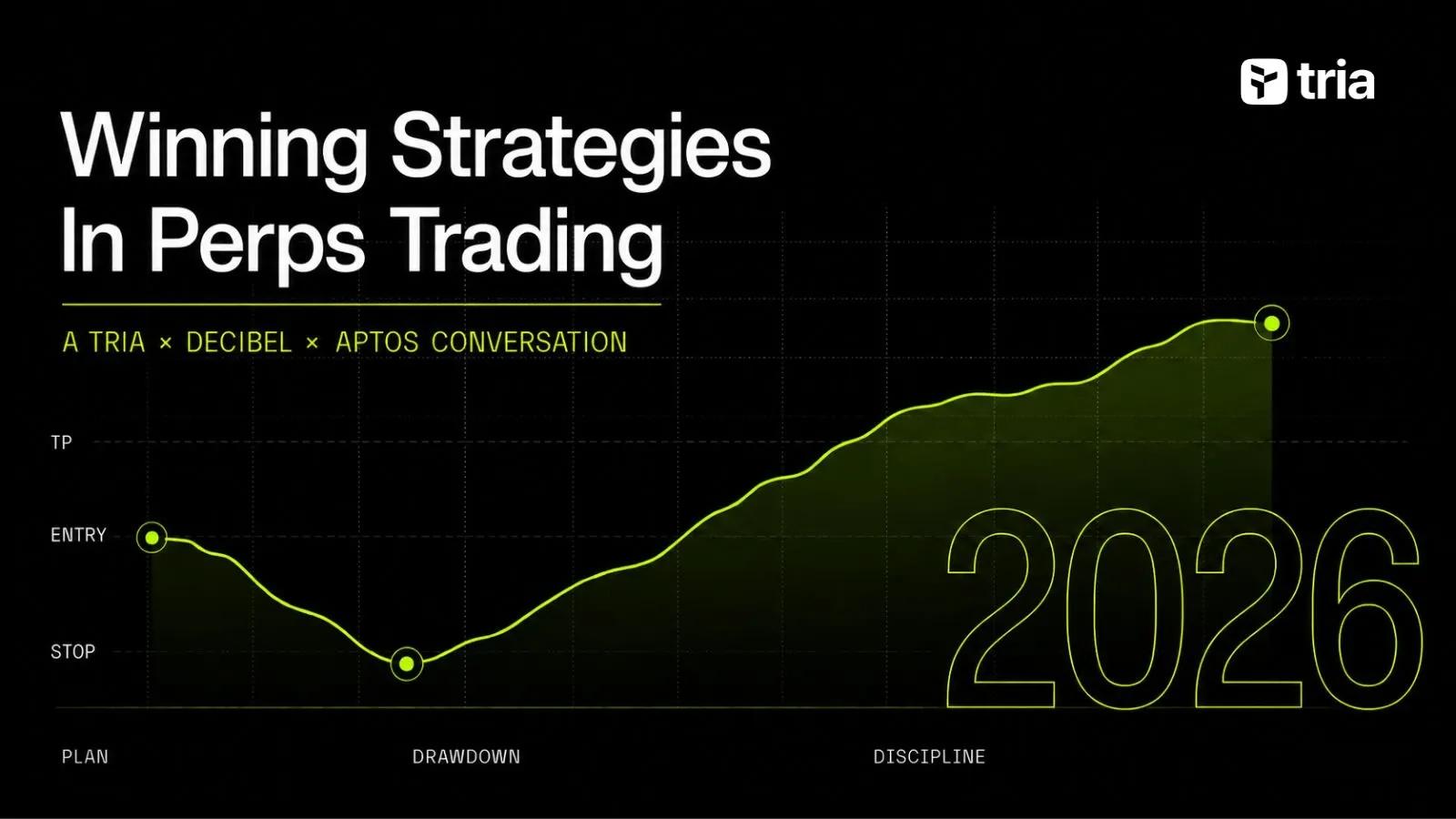

Tria recently hosted an X Space, "Winning Strategies in Perps Trading," with about 1,200 live listeners. The panel was unusually qualified: Bradley ("Bry"), Head of the Decibel Foundation, with five-plus years in liquid prop trading; Calvin (Cho) from the Aptos DeFi team; and Parth and Ronald from Tria. What follows is the actual substance — not a summary of platitudes, but the specific strategies and mistakes they discussed
Why active traders moved from spot to perps
Perpetual futures overtook spot as the default market for active crypto traders for one reason that matters more than the adrenaline: capital efficiency. When you have edge, you don't want to lock all of your capital into a single position to express it. A perp lets you commit a small slice of your portfolio and still get the full exposure you want. You deploy a little, you access leverage, and you keep the rest of your capital free for everything else. That flexibility — not the thrill of high leverage — is the real engine behind perps adoption.
It helps to be precise about what you're actually trading. A perpetual future is a futures contract with no expiry date. Unlike a dated oil contract you'd have to roll over, you and your counterparty can hold a perp open indefinitely. The mechanism that keeps its price tethered to the underlying spot asset is the funding rate — which, as you'll see, becomes a strategy input in its own right.
What separates perps trading from gambling
Leverage earned its reputation in 2021, and it wasn't a flattering one. The line between trading perps and gambling with leverage isn't the instrument — it's the approach. Trading means analyzing the market, reading news and events, entering with a structured plan, and knowing your exit before you need it. Gambling is doing the same trade without any of that.
The part most people skip is the exit. A real plan accounts for the trade going against you, not just for the win. You decide, before you enter, what invalidates the thesis and what you'll do when it does. Everything else in this article is downstream of that single discipline.
How to read funding rates, open interest, and liquidations
This is the most technical skill in perps, and the one most worth getting right.
Funding rates signal positioning, not direction
The base funding rate normally sits around 10% annualized. When you see a strongly positive funding rate, more longs than shorts are pushing into the market — traders are bullish and believe the move they're anticipating is bigger than the funding they're paying to hold the position. If they're paying 40% annualized, they expect the asset to move more than that over their time horizon. A strongly negative rate is the mirror image: traders are positioned for a large down move and are willing to pay a high short-side cost to be there for it.
Open interest is about activity, and where it opens
Open interest tells you how active a market is, and — more usefully — where positions are opening. When size enters at a specific price level, the question worth asking is whether those traders are anticipating an announcement, positioning ahead of news, or whether it's noise. Sometimes a large position appears for no reason you can explain until well after the fact. That's normal. The signal is in the pattern, not the single print.
Treat the metrics as a read on the crowd, not a verdict
Here is the framing that turns these numbers into something usable: funding rates, open interest, spot volume, and volume across different venues are not concrete indicators. Used together, they tell you what other traders are collectively thinking. The crowd may be right or wrong — that's not the point. Your job is to interpret the positioning and decide where you stand against it, not to treat any one metric as permission to act.
The real winning strategy is having one at all
The most important move in perps trading is almost tautological: have a strategy. Know where you see strength and weakness in the market, define your entry and your exit, build the thesis on as much information as you can gather, and decide in advance what you'll do when it breaks.
The failure mode worth memorizing is an asymmetry in human behavior: people rush in too quickly when they think they're about to make money, and they wait far too long to act when they're losing it. Most account damage isn't a bad entry — it's holding a loser long after the thesis that justified it has already broken.
There's a nuance here that gets misunderstood. Reacting fast to news isn't always wrong. A trader with years of built-up market intuition can act on a headline in seconds and be right — but that speed is the output of accumulated judgment, not a substitute for it. And it still carries exit risk: the same news cycles reverse, and a fast entry with no exit plan is how you end up unable to get out. Speed is not a strategy. It's something a strategy occasionally permits.
Build a rule set and keep a trade journal
If there is one section to act on, it's this one.
Trade the regimes you're actually good at
Bull markets, and markets about to turn bull, tend to offer the best risk-to-reward — even a wrong call there usually doesn't wreck you. If you're weak at shorting or at chopping sideways markets, stop forcing directional trades into them. In flat or bearish conditions, funding-rate arbitrage, new-listing plays, and yield strategies often beat insisting on a directional bet you don't have an edge in.
Your entry can be imperfect; your stop loss cannot
Internalize this as a rule: the entry doesn't have to be perfect, but the stop loss has to be. A clear, pre-committed set of rejection criteria is what keeps emotion out of the moment when it matters most.
Keep a trade journal
This is the most underrated, lowest-effort, highest-compounding habit in trading. Write down the reason for every trade — win or lose, before you know the outcome. Even when the reasoning turns out wrong, the act of articulating it forces the kind of thinking that improves the next decision. One concrete rule worth stealing for the journal: when spot volume is low but perp open interest is high over a short window, expect a quicker pullback and trim low-conviction positions — that pattern means people are leveraging short-term news, not accumulating spot for the long term.
Where most perp traders actually lose money
Three failure patterns account for most blown accounts.
The first is borrowed conviction. Taking a trade because someone else is in it — without understanding their thesis, their stop, or their take-profit — means you don't even know if they're selling while telling you to buy. Copying a trade you can't explain is never a good entry, and it isn't alpha. It's chasing someone who may simply be performing confidence in public.
The second is the absence of a real stop, usually paired with FOMO into something that has already run. Fumbling into a token that's pumped for days, with no level at which you admit you're wrong, is the most common way to get wrecked. If you're early in your trading, the antidote is mechanical: size small, use isolated margin so a single trade can only cost you what you put into it, and treat risk assessment as the first step rather than the afterthought.
The third is spreading yourself across too many ideas. The discipline that compounds is narrow: you only need to be right on a few things to make money — not on everything that sounds interesting. In a market where everything sounds compelling and everyone sounds smarter than you, conviction in a small number of well-chosen positions beats scattered participation in all of them.
Conviction and discipline are not the same thing
Conviction is widely misunderstood. It doesn't mean "this asset has fundamentals." It means you're convinced of your strategy. If your strategy is to chase a narrative, that can be fine — provided you're disciplined about take-profits and stops while you do it. If your conviction is a genuine long-term thesis, then setting stops so tight that ordinary volatility shakes you out actively works against you. Conviction and discipline operate together; weaken one and the whole strategy breaks. In practice that looks like: conviction-driven positions over high-leverage gambles on memes, no emotional attachment to a trade, and the patience to skip a coin that's already done 2x in two days.
Why leverage exposes psychology faster than anything else
Leverage scales gains and losses against the capital you actually deployed. A 10x position moves the number ten times as fast in both directions. If you haven't decided in advance how much of that volatility you can stomach, leverage will surface the answer immediately — and usually at the worst possible moment. This is the practical reason discipline has to be built before the position is open, not improvised after the swings begin.
Take profit before the regret spiral starts
A profitable position creates a specific psychological trap: it makes you want more, right up until the market reverses and erases the gain. The cleanest defense on a perp is the partial close — bank some profit while keeping your original entry and staying in for further upside, rather than holding the entire position hostage to a target you're not sure it will reach.
A lower-stress version of the same idea: keep leverage modest — many disciplined traders rarely exceed 2–3x of their cross-margin portfolio — and set a take-profit slightly below the current price based on technicals, so the position closes itself even while you sleep. Underneath both methods is the real lesson: this is continuous learning. Market structure changes, the other participants change, and a strategy that printed last cycle has to keep adapting or it stops working.
The mindset it all reduces to
Strip away the tactics and three habits remain. Have a strategy at all — that alone separates you from most of the market. Build a rule set that's yours, because your conviction differs from the person next to you and so should your rules. And keep a trade journal, because it's the cheapest edge available and almost nobody does it. Layered on top of all three is patience: don't let euphoria or fear override the plan you wrote, and never put your survival on a single trade.
Where Tria fits
Most of this is about how to trade, not about Tria. But the reason Tria convened this conversation is relevant. Tria integrates Decibel, a fully on-chain, transparent perps DEX built on Aptos. Decibel provides the exchange infrastructure — liquidity, the matching engine, and the risk engine that handles liquidations — and Tria wraps that back end in a front end that abstracts away gas, bridging, and deposits.
One necessary caveat: perps trading is high-risk. Leverage amplifies losses as much as gains, and even experienced traders talk openly about getting wrecked. Nothing here is financial advice — it's how seasoned traders think about managing that risk.
Download Tria to explore the trading product.
Frequently asked questions
What is the most important perps trading strategy?
The single most important thing is having a defined strategy at all — a written thesis with entry, exit, and a plan for when the trade goes wrong. Better entries matter far less than having a rule-based plan and the discipline to follow it.
How do you read funding rates in perps trading?
The base funding rate is normally around 10% annualized. A high positive funding rate means more longs than shorts and a bullish crowd; a strongly negative rate means traders are positioning for a large down move. Funding rates aren't a direct buy/sell signal — used alongside open interest and spot volume, they help you read what other traders are collectively thinking.
Why do most perp traders lose money?
Three recurring causes: trading on borrowed conviction (copying someone else's trade without knowing their thesis or exits), weak or missing stop losses, and FOMO-ing into assets that have already pumped without analysis. The fix is a personal rule set, disciplined stop losses, and trading only a few high-conviction ideas rather than everything that sounds interesting.
Is high leverage a good idea in perps trading?
The consensus leans conservative — many traders rarely exceed 2–3x of their cross-margin portfolio. Leverage amplifies both gains and losses relative to deployed capital and exposes trader psychology quickly. Less experienced traders should start with small amounts and use isolated margin to cap risk.
How do you take profit on a perps position?
Use partial closes — bank some profit while keeping the same entry and position open for further upside, rather than holding the whole position waiting for a number you're not sure it will reach. Another approach is a technically-placed trailing take-profit that auto-closes the position.