
Operating systems spanning consumer finance, infrastructure, and autonomous agents require coordination mechanisms that expand with usage. This article examines TRIA's utility, supply mechanics, allocation, and vesting within the complete architecture.
Why TRIA Is Part of the System
Tria integrates two coupled elements: a consumer-focused neobank and a permissionless infrastructure layer serving applications, institutions, and AI agents. Coordinating value movement across chains, participants, and execution settings demands solutions beyond custodians, centralized pricing, or fragmented incentives.
- Settlement and routing across all Tria activity
- Participation security in BestPath via staking and accountability
- Incentive alignment among users, operators, developers, and partners
- Governance over protocol parameters and ecosystem programs
How TRIA Functions Today
Currently, TRIA operates across five primary utility domains. BestPath settlement — TRIA facilitates all BestPath settlements, with growing transaction volume increasing settlement demand. Staking and routing access — PathFinders stake TRIA to access BestPath markets and perform routing and verification operations. Gas and fee subsidies — TRIA covers gas, trading, spend, FX, and subscription costs, reducing user expenses as adoption increases.
Governance — TRIA enables token-weighted governance over protocol parameters, emissions, and ecosystem choices. Membership benefits — TRIA holders obtain tiered advantages and reduced fees across platform services. Protocol roadmaps extend TRIA utility toward capital markets modules including lending and borrowing, remittance and global payment settlement support, extended governance participation, and additional ecosystem incentive programs.
Supply Overview
- Total supply: 10,000,000,000 TRIA
- Monetary policy: Fixed supply, hardcapped
- Emission model: No inflation, all tokens pre-minted at TGE
- Token standard: ERC-20 on Ethereum mainnet
- Circulation mechanism: Vesting unlock schedules only
- Genesis circulating supply: 2,157,756,000 TRIA (21.58%)
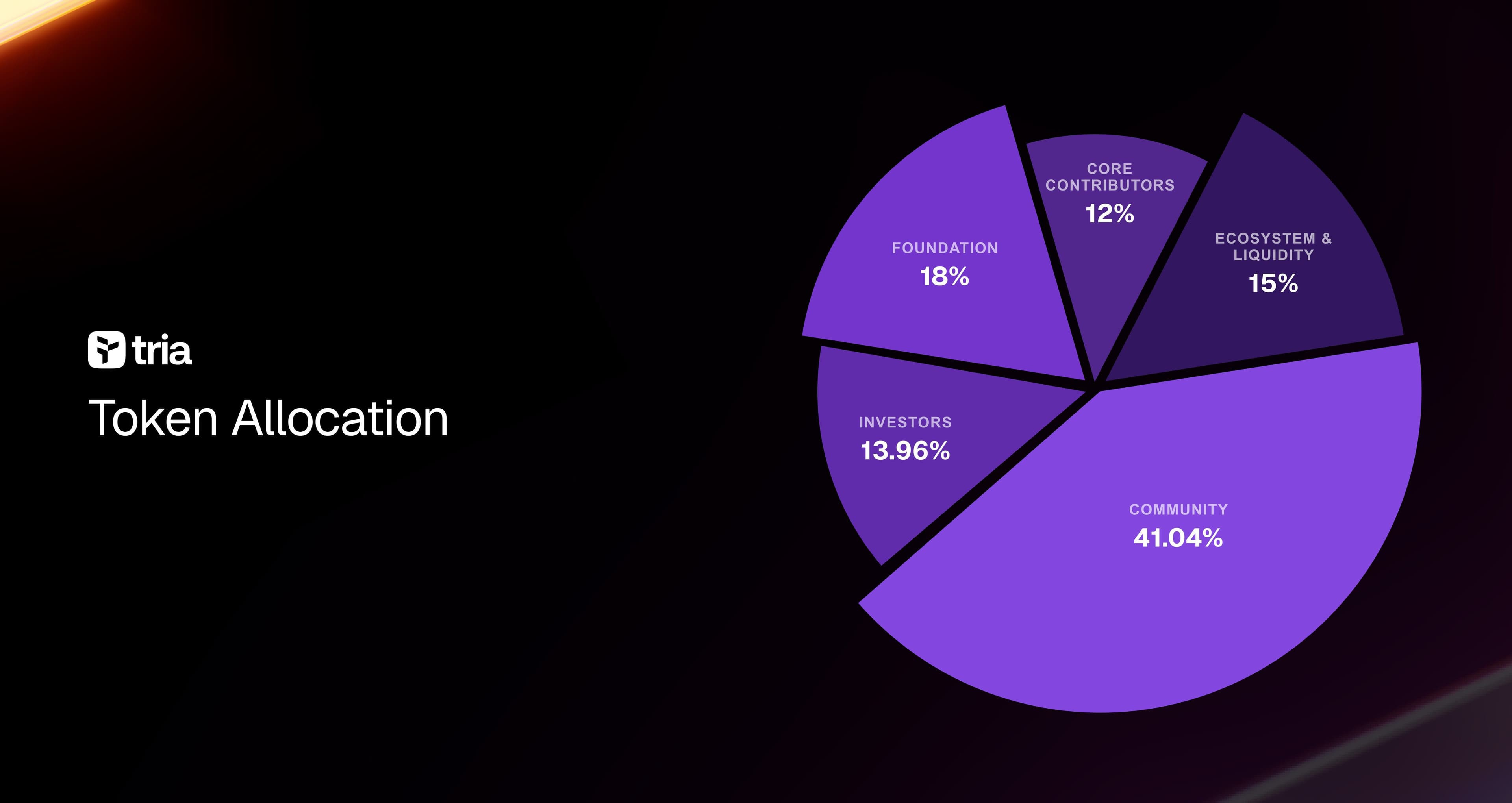
Token Allocation
- Community: 41.04%
- Foundation: 18.00%
- Ecosystem and Liquidity: 15.00%
- Investors: 13.96%
- Core Contributors: 12.00%
Community: 41.04%
The Community allocation represents the primary TRIA supply share, reserved for active network users, developers, and supporters. This allocation finances user incentives, ambassador initiatives, ecosystem rewards, and community-driven programs generating real usage across spending, trading, and earning. Allocating the largest supply portion to community members connects token ownership with genuine participation rather than passive investment.
Foundation: 18.00%
The Foundation allocation backs long-term protocol operation, governance, and continuity. These tokens fund protocol advancement, research, legal compliance, ecosystem grants, security evaluations, and operating expenses required for managing a global self-custodial financial system. This allocation supplies Tria with operational capacity for multiple years independent of temporary incentives or external reliance.
Ecosystem and Liquidity: 15.00%
The Ecosystem and Liquidity allocation targets liquidity establishment, venue development, integration assistance, and expansion across chains, wallets, applications, and payment rails. These tokens incentivize protocol connections, exchange liquidity provisioning, partnership advancement, and consistent execution across consumer and infrastructure components.
Investors: 13.96%
The Investor allocation reserves tokens for early supporters supplying capital, strategic direction, and confidence during initial development stages. Investor tokens remain locked at TGE under extended vesting arrangements, aligning external investment with long-term strategy and ensuring investor involvement links to persistent network development.
Core Contributors: 12.00%
The Core Contributors allocation designates tokens for teams and builders constructing, maintaining, and scaling consumer products and infrastructure. These tokens follow delayed, multi-year vesting timelines aligning development leadership with extended protocol welfare.
Vesting Schedule Overview
Initial circulating supply principally allocates to users, community members, and ecosystem contributors. Team and investor allocations unlock gradually across extended vesting arrangements, ensuring early incentives concentrate on authentic usage and persistent network development.
Closing
Tria's mission involves making programmable money operate like the internet: instant, global, and self-custodial. TRIA furnishes coordination, settlement, and incentive alignment enabling Tria to operate as a unified financial system spanning users, applications, and infrastructure.
Every allocation decision was made with one question in mind: does this create a network that becomes more valuable as more people use it?